
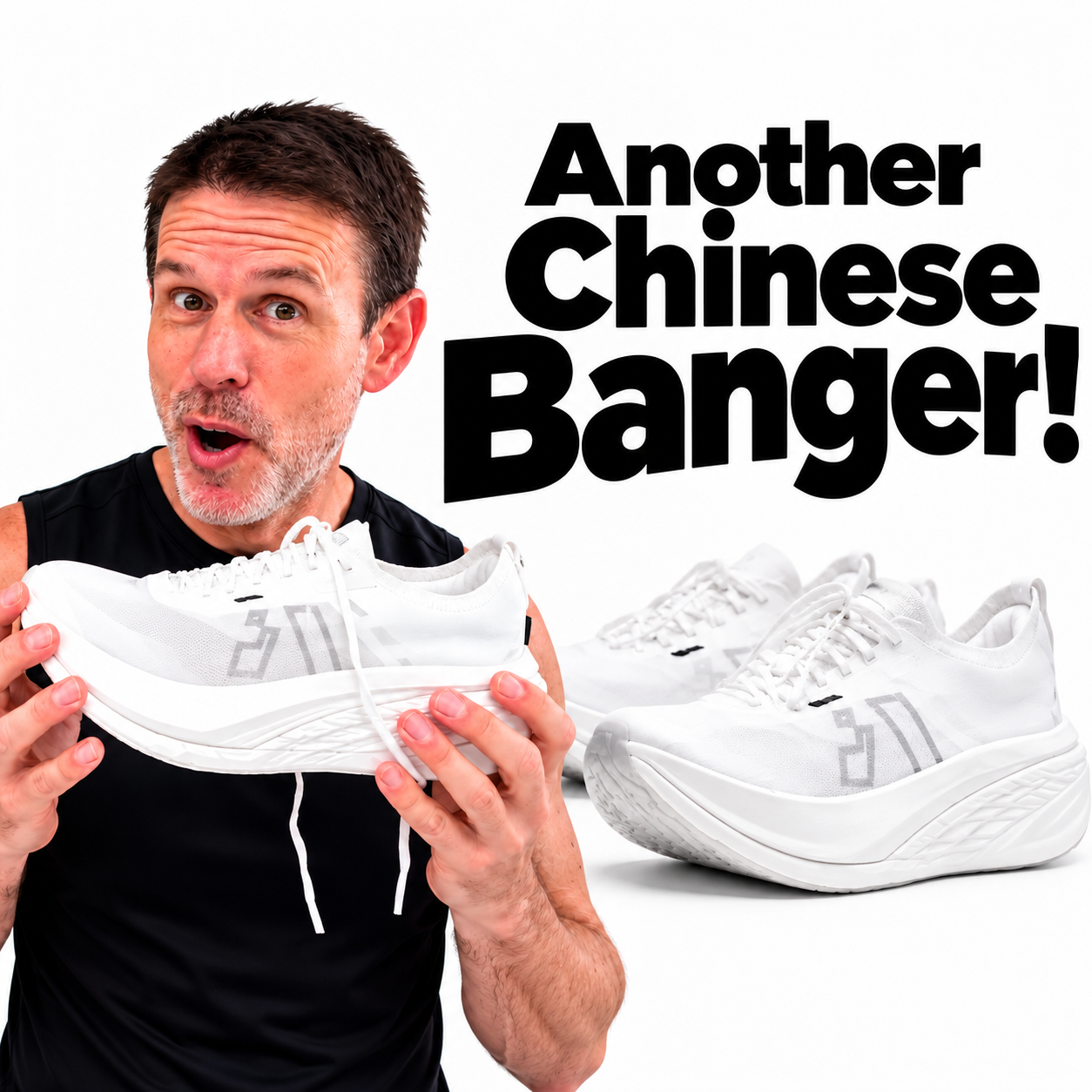
Runsifly Flare Elite Race Review
A Lightweight Chinese Super Shoe That’s an Absolute Banger
The Runsifly Flare Elite is one of those shoes that makes you question just how much you really need to spend on a carbon-plated racing shoe.
I bought my pair from AliExpress for around £110, they arrived on Saturday, and I did exactly what you are not supposed to do: I raced in them the following morning with no proper test run beforehand.
That race was the Middlesex County 10K Championship at Victoria Park in London.
Not ideal preparation.
But as first runs go, this one told me almost everything I needed to know.
The Flare Elite is light, soft, bouncy, aggressively rockered and extremely fast. I ran 36:27, won my age category, and came away genuinely impressed with how effortless the shoe felt over a flat 10K course.
This is not just a good shoe for the money.
It is a very good racing shoe.
Runsifly Flare Elite Specs
Category: Carbon-plated racing shoe
Weight: 187g in my UK 8.5
Stack height: 39mm heel / 31mm forefoot
Drop: 8mm
Midsole: Soft PEBA-based super foam
Plate: Full-length carbon plate
Upper: Ultra-lightweight translucent race mesh
Outsole: CPU rubber
Best for: 5K, 10K and half marathon racing
Price paid: Around £110 from AliExpress
Fit and Sizing
The Flare Elite is quite roomy for a racing shoe.
I went down half a size and that worked very well for me.
There is plenty of space in the toe box and the shoe does not taper aggressively around the toes, so runners who prefer a bit more room could probably stay true to size.
For me, half a size down gave me the secure race-day fit I wanted without making the forefoot feel cramped.
The midfoot narrows more noticeably, which helps lock the foot into place.
Overall, the fit is compact and secure without feeling excessively tight.
Upper
The upper is extremely minimal.
It is translucent, very thin and clearly designed around reducing weight.
Whatever sock you are wearing will effectively become part of the colour of the shoe, which is actually quite a nice touch on the white version.
The material reminds me a little of the 361° Miro Nude racing shoe. It has that almost plasticky, ultra-light race-day feel, but it still wraps around the foot surprisingly well.
There is very little structure, but I never felt as though my foot was sliding across the platform.
The laces are excellent, and although there is not much padding underneath them, I had no issues with lace bite.
What surprised me most was the amount of padding around the heel collar and heel counter.
For a shoe this light, the rear of the shoe feels more comfortable and secure than expected.
I also did not need to use a runner's knot.
Upper Score: 5/5
It is minimal, lightweight and does exactly what a race upper should do.
Midsole
This is where the Flare Elite gets really interesting.
The midsole is excellent.
The foam is soft, energetic and compresses very quickly under load before springing back.
But the real star is the geometry.
The rocker starts extremely early.
As soon as you land around the midfoot or forefoot, you feel as though you are already on a curve and being rolled onto your toes.
It creates a very smooth transition.
You land, the foam compresses, and the geometry immediately starts pushing you forwards.
That combination made the shoe feel effortless on the long straight sections around Victoria Park.
The shoe also feels as though there may be a slightly softer compound above the carbon plate and a firmer layer underneath it.
Whether that is technically a dual-density construction or simply the way the foam and plate interact, the effect is useful.
You get softness and bounce on landing, while the lower part of the platform feels more controlled.
The carbon plate itself did not feel particularly aggressive during my first run.
That may actually be a positive.
Rather than feeling as though the plate is dictating your stride, it works quietly underneath the foam and rocker.
I would also expect the shoe to improve slightly as the foam breaks in.
Midsole Score: 5/5
Soft, lively, smooth and extremely enjoyable at race pace.
Ride
The ride is where the Flare Elite really won me over.
This shoe wants to move.
It feels best when you get onto your midfoot or forefoot, increase your cadence and let the rocker do the work.
It is not the type of racing shoe where you feel a huge, rigid carbon plate forcing you forward.
Instead, the sensation is softer and smoother.
The foam gives you the bounce.
The rocker gives you the roll.
The weight makes everything feel quick.
During the Middlesex 10K, I could really open up on the long flat stretches and allow the shoe to keep turning over underneath me.
That was particularly noticeable given that I do not currently feel as though I am at peak fitness.
At the Sheffield 10K I had run roughly 37:16-37:19.
At Victoria Park, I ran 36:27.
The course is flatter, so this is not an apples-to-apples comparison, but I came away feeling that the Flare Elite helped me maintain pace extremely well.
Speed
This is unquestionably a fast shoe.
At 187g in my size, there is virtually nothing on your foot.
Combine that low weight with the early rocker and responsive foam and you have a shoe that actively encourages quick turnover.
If you are running well and getting onto the front of the shoe, it feels like it wants to keep accelerating.
I am particularly interested in trying it over 5K.
The combination of low weight and aggressive geometry could make it very effective over shorter distances.
Speed Score: 5/5
It is one of the fastest-feeling racing shoes I have tested recently.
Stability
Stability is probably the Flare Elite's biggest weakness.
The forefoot is reasonably broad, but the platform narrows substantially through the midfoot and heel.
That means the shoe feels most stable once you are up onto the front of it.
Land further back and it becomes noticeably less secure.
There are also very few structural elements in the upper to add additional support.
I would describe it as a very neutral racing shoe.
That said, I still find it more stable than the HOKA Cielo X1 3.0.
The shoe I would choose instead if stability were a major priority is the Topo Specter 2 / Specter Elite-type platform, which provides a noticeably broader base.
Stability Score: 3.5/5
Fine for efficient neutral runners, but not a shoe I would recommend primarily for stability.
Outsole
The outsole is very good.
There is CPU rubber covering most of the important contact areas, with only small sections of exposed midsole foam.
Grip was excellent during my race.
I did notice a couple of small exposed areas that reminded me of some of the wear concerns seen on shoes such as the adidas Adizero Adios Pro 5, although I have not seen any meaningful damage yet.
After one race, there is really only some light discolouration.
It is far too early to make any serious durability judgement, but the rubber coverage gives me confidence.
Outsole Score: 5/5
Excellent grip and much better coverage than you might expect from a shoe this light.
Durability
It is too early to properly score durability.
The soft midsole already shows some creasing, but that is normal for this kind of PEBA-based foam.
The outsole coverage is encouraging.
I will need considerably more mileage before making any firm judgement.
Runsifly Flare Elite vs HOKA Cielo X1 3.0
The HOKA Cielo X1 3.0 is one of the shoes that immediately came to mind when running in the Flare Elite.
Both have:
aggressive early-stage rockers
soft, responsive midsoles
lightweight race-day constructions
a strong forward-rolling sensation
The Runsifly is considerably lighter.
I also find it slightly more stable than the Cielo X1 3.0.
The HOKA gives you a little more cushioning under the forefoot, but in terms of outright speed, I would probably give the Flare Elite the slight edge.
That is impressive considering the price difference.
Runsifly Flare Elite vs Topo Specter
The Topo is the more stable option.
It has a broader platform and would probably be my preference for runners who want a more secure feeling over longer distances.
The Runsifly is lighter, more aggressive and probably faster.
If you took some of the stability and smoothness of the Topo and mixed it with the aggressive geometry of the Cielo X1 3.0, you would end up with something very close to the Flare Elite.
Best Distance for the Runsifly Flare Elite
For me, the sweet spot is probably between 5K and half marathon.
5K
I think this could be excellent.
The low weight, quick turnover and rocker should work very well at faster paces.
10K
This is already proven for me.
I raced 10K in it straight out of the box and thought it was superb.
Half Marathon
This might actually be the ideal distance.
The soft foam and rolling geometry should work extremely well when you want to hold a hard but sustainable pace for a longer period.
Marathon
Potentially.
The weight would certainly be a major advantage over 26.2 miles.
My concern would be stability.
Over the marathon distance, especially once your mechanics start deteriorating, I am not yet sure whether I would want such a narrow platform.
I would need to test it over longer runs before recommending it confidently for the marathon.
Value
This is where things become difficult for the established brands.
I paid roughly £110.
At that price, this shoe is exceptional value.
You are getting:
a carbon plate
high-energy foam
an extremely low weight
excellent outsole grip
a proper race-day geometry
and genuine super-shoe performance.
Value Score: 5/5
At around £110, it is difficult to argue with.
Who Should Buy the Runsifly Flare Elite?
I would recommend the Flare Elite to runners who:
like highly rockered shoes
prefer a soft and bouncy ride
want an extremely lightweight racer
land around the midfoot or forefoot
enjoy a quick, rolling transition
race from 5K through to half marathon
want super-shoe performance without paying £200+
I think lighter runners may particularly enjoy it.
Heavier runners, or runners who need more stability, may prefer something with a broader base.
Race Performance
My first run in the shoe was the Middlesex County 10K Championship.
I ran 36:27 and won my age category.
Considering I had not run a single proper mile in the shoe beforehand, that is about as good a first test as I could have hoped for.
What impressed me most was not simply the time.
It was how smooth the shoe felt.
On the long sections through Victoria Park, I could reach forward, engage the rocker and allow the shoe to keep rolling beneath me.
It felt efficient rather than frantic.
That is exactly what I want from a racing shoe.
Final Verdict
Should you buy the Runsifly Flare Elite?
Yes.
If you like lightweight racing shoes, soft super foams and aggressive rocker geometry, this is an absolute weapon.
The upper is excellent.
The outsole is excellent.
The midsole is excellent.
The ride is fast, smooth and genuinely fun.
Its main weakness is stability, and I would be slightly cautious about recommending it to runners who land heavily through the heel or who need a lot of support.
But for neutral runners who like getting onto the midfoot and forefoot and pushing the pace, this is one of the most exciting Chinese racing shoes I have tested.
And at around £110, the value is ridiculous.
Nike, adidas, HOKA, Saucony and the other established brands should be paying attention.
Chinese running shoes are no longer simply cheaper alternatives.
Shoes like the Runsifly Flare Elite are becoming genuine competitors.
Overall Scores
Upper: 5/5
Midsole: 5/5
Outsole: 5/5
Speed: 5/5
Stability: 3.5/5
Value: 5/5
Best for: 5K to half marathon racing
Best feature: Lightweight, soft and aggressive rolling ride
Main weakness: Narrow platform and limited stability
Overall verdict: It's a banger.
“Should you buy the Runsifly Flare Elite?
If you like lightweight racing shoes, soft super foams and aggressive rocker geometry, this is an absolute weapon.”
”
Want to Know More?
If you're interested in finding out more about this shoe - Please fill in the following form.