
ASICS Metaspeed Ray Tokyo Review
An Ultra-Light 5K/10K Weapon
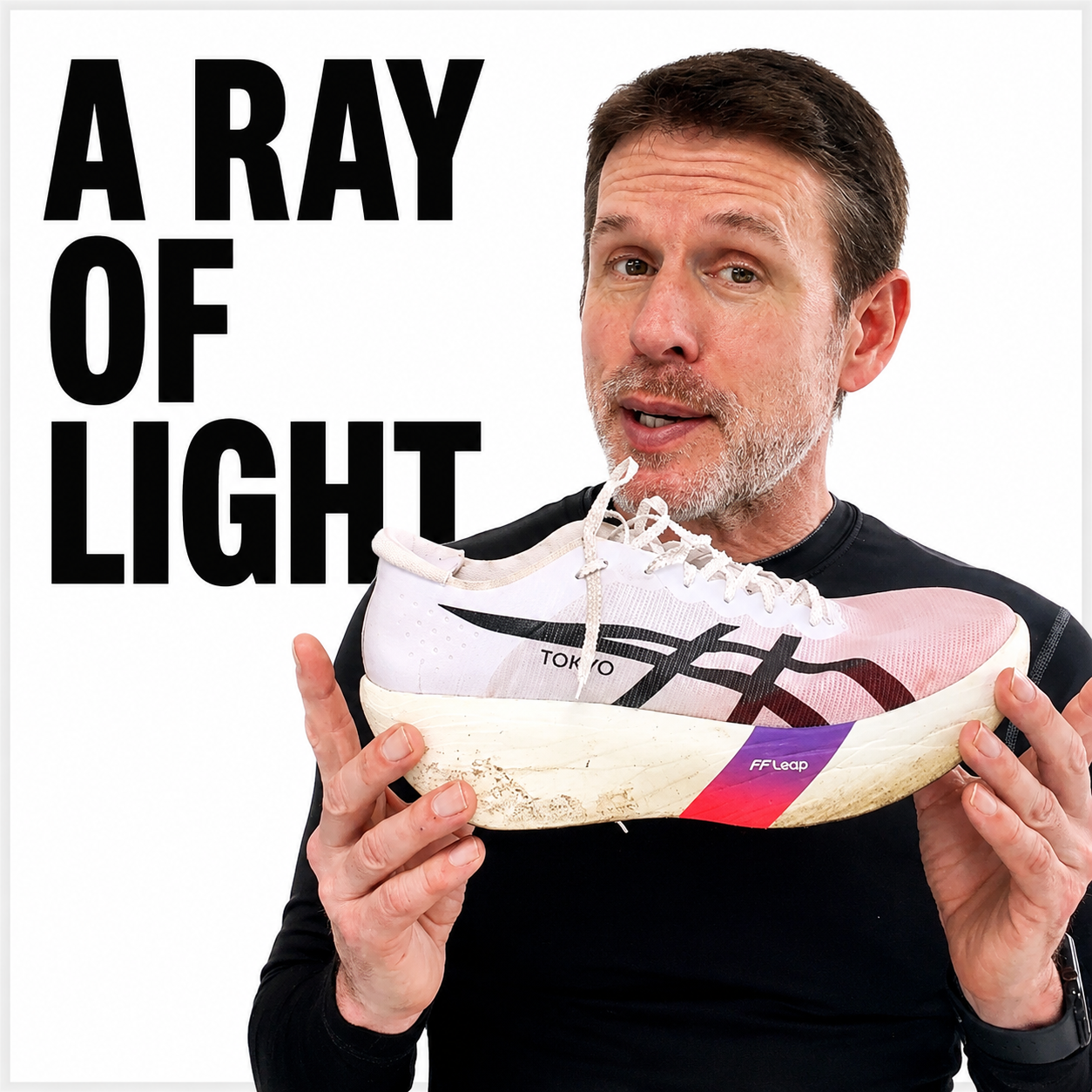
The ASICS Metaspeed Ray Tokyo is one of the lightest and most exciting racing shoes I’ve used. At just 133g in my UK size 9.5, it feels almost weightless on foot, and that sensation carries directly into the ride.
I raced it at the ASICS London 10K, running 35:42 on a course with lots of tight turns and turn-backs. It wasn’t a PB course, but the shoe still felt incredibly fast, bouncy and efficient throughout.
Overview
The Metaspeed Ray Tokyo feels like a more extreme interpretation of the Metaspeed line.
It takes some of the best characteristics of both the Metaspeed Sky Tokyo and Metaspeed Edge Tokyo, then packages them into an incredibly lightweight racer.
The big difference is the construction:
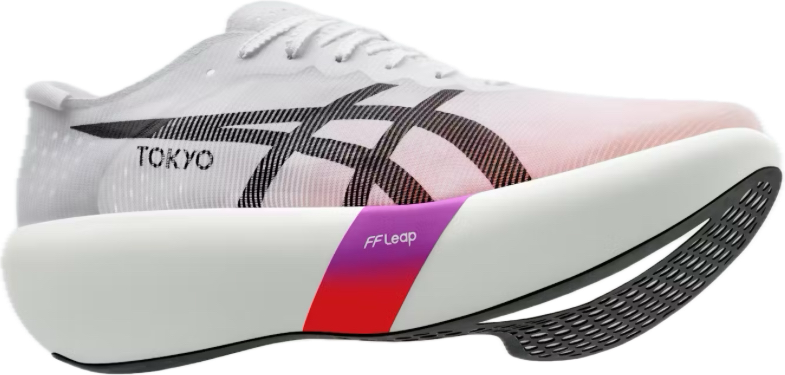
Full-length FF Leap foam
Half-length carbon plate
Very aggressive early-stage rocker
Extremely minimal upper
Almost no unnecessary weight
Very soft, bouncy ride
The result is a shoe that can be spectacular if your running style matches it.
But it is not versatile.
You need to land forward.
Key Stats
In my UK size 9.5:
Weight: 133g
Heel stack: approximately 39.5mm
Forefoot stack: approximately 34.5mm
Drop: 5mm
Midsole: FF Leap
Plate: Half-length carbon plate
Fit: Narrow and low-volume
Ride: Very soft, extremely light and highly responsive
That 133g weight is remarkable.
For comparison, it is significantly lighter than the Metaspeed Sky Tokyo, Metaspeed Edge Tokyo and Puma Fast-R Nitro Elite 3.
You genuinely feel like there is almost nothing on your feet.
Upper – 5/5
The upper is one of the best I’ve used.
It is extremely thin, lightweight and flexible, but still has enough structure to hold the foot securely.
What surprised me was how well it accommodated my wider feet despite the shoe itself being visibly narrow.
The material molds around the foot rather than fighting against it.
There was:
No rubbing
No toe abrasion
No hot spots
Good lockdown
Very little heel movement
The laces are excellent as well.
The tongue could be slightly better — it is a little short and not gusseted — but that wasn’t enough of an issue for me to mark the shoe down.
The heel collar is very minimal but does enough to hold the ankle securely.
This is exactly what I want from a race upper.
Upper score: 5/5.
Midsole – 5/5
The midsole is where the Ray Tokyo becomes really interesting.
Unlike the Sky and Edge Tokyo, this shoe uses FF Leap throughout the entire midsole.
That makes it softer, bouncier and less stable.
The half-length carbon plate sits in between the configurations used in the Sky and Edge.
For me, that position is almost perfect.
I engage the plate more than I do in the Edge, but slightly less than I do in the Sky.
The result is a very natural combination of:
compression + bounce + plate engagement + rocker
You land, compress the soft foam, engage the plate and then get a nice ping forward.
It isn’t an excessively mechanical feeling.
The foam is doing a lot of the work.
The early-stage rocker then keeps you moving smoothly through toe-off.
That means it works well for runners who like to increase cadence, but there is also enough softness and rebound for runners who like to lengthen their stride.
For me, it feels like a supercharged combination of the Sky and Edge Tokyo.
Midsole score: 5/5.
Outsole
The outsole tells you exactly how ASICS expects you to run in this shoe.
There is decent coverage underneath the forefoot.
The heel, however, contains a substantial amount of exposed FF Leap foam.
That means two things.
First, this shoe is designed primarily for runners who land towards the front.
Second, heavy heel strikers are likely to wear it out rapidly.
If you consistently land at the heel, I would avoid the Ray Tokyo altogether.
Not only will durability suffer, but because the carbon plate doesn’t extend all the way back, you are landing directly onto an extremely soft and unstable foam platform.
For forefoot runners, though, the outsole setup makes much more sense.
Stability – 2.5–3/5
Stability is the Ray Tokyo’s biggest weakness.
The combination of:
Very soft foam
Narrow platform
No sole flare
Half-length plate
means that this shoe requires good form.
On straight sections, I had very few problems.
Tight turns were a completely different experience.
The London 10K contained a number of sharp U-turns and tight corners, and I had to actively control the shoe through those sections.
Because my foot is wider than the platform, it almost felt like the foot was hanging slightly over the edge.
On sharp turns, I could feel myself beginning to topple and having to correct my foot placement.
This is not the shoe for runners with significant stability requirements.
Stability score: approximately 2.5–3/5.
Speed – 5/5
This shoe is seriously fast.
Despite the London 10K being far from an ideal course for the Ray Tokyo, I still ran 35:42, one of my fastest 10Ks of the year.
The weight is probably the first thing you notice.
At 133g, your turnover feels incredibly easy.
But there is more going on than simply low weight.
You also get:
Excellent energy return
Strong forefoot bounce
Useful plate engagement
Fast rocker transition
Easy cadence
The Ray Tokyo feels very different from something like the Puma Fast-R Nitro Elite 3.
The Puma is firmer, more mechanical and more aggressively propulsive.
The ASICS is softer, lighter and more fluid.
Both are incredibly quick.
For the right runner, this could absolutely be a PB shoe.
Speed score: 5/5.
Durability – 2.5–3/5
This is another weakness.
The shoe is extremely stripped back, and there is a large amount of exposed foam.
For a forefoot striker like me, that will help preserve the shoe somewhat because the main landing area is protected.
But I still wouldn’t expect enormous mileage from it.
My feeling is that somewhere around 200–300 miles would already be a good result.
For heavier runners or heel strikers, it could be considerably less.
This is absolutely a race-day-only shoe.
Using it regularly for training would waste one of its biggest strengths and reduce its lifespan unnecessarily.
Durability score: approximately 2.5–3/5.
Ray Tokyo vs Sky Tokyo vs Edge Tokyo
This is where the Ray becomes particularly interesting.
Metaspeed Sky Tokyo
The Sky gives you:
Higher, flatter plate
More noticeable plate engagement
Strong toe-off
More structure
Slightly firmer ride
Metaspeed Edge Tokyo
The Edge gives you:
Lower plate
Less plate engagement
More emphasis on cadence
More conventional transition
Metaspeed Ray Tokyo
The Ray sits somewhere in between.
You get:
Softer foam
More bounce
Half plate
Very low weight
More freedom in the forefoot
More instability
It feels like ASICS has taken aspects of both shoes and then removed almost everything that wasn't essential.
Who Is It Good For?
The Ray Tokyo is very runner-specific.
5K – Excellent
This could be one of its strongest distances.
On a fast, relatively straight course, the low weight and aggressive transition should be devastating.
10K – Excellent
The London race proved this.
Even on a course that didn’t suit it particularly well, it still performed brilliantly.
Half Marathon – Very Good
I think it could work well, particularly for lighter runners with excellent form.
The question is whether you can maintain that forefoot strike for the whole distance.
Marathon – Potentially Excellent, But Risky
This is the big unknown.
If you can stay forward on the shoe for 26.2 miles, it could be incredible.
But that requires very good form.
Once fatigue sets in and your foot strike begins drifting backwards, the lack of plate and stability in the heel could become a real issue.
That is why I would test it over a half marathon before committing to a marathon.
Best Suited To
I think the Ray Tokyo is particularly well suited to:
Lightweight runners
Forefoot strikers
Midfoot strikers
Efficient runners
High-cadence runners
Runners who like soft super shoes
Runners who enjoy aggressive rocker geometry
Faster runners capable of maintaining good form
Heel strikers should be very cautious.
Heavy heel strikers should probably look elsewhere.
Value – 2.5/5
At around £265, this is an expensive running shoe.
The price becomes even harder to justify when you consider the likely durability.
It is essentially a specialist racing tool.
That doesn’t mean it isn’t worth owning.
If you are chasing PBs and this style of shoe suits your mechanics, you may feel the performance justifies the price.
But in terms of pure value, there are far cheaper super shoes available.
Value score: 2.5/5.
London 10K Race Performance
The ASICS London 10K was actually a difficult test for the Ray Tokyo.
There were plenty of corners and multiple turn-backs, which exposed the shoe's biggest weakness.
It simply isn't comfortable through sharp changes of direction.
But on the faster, straighter sections, it was excellent.
The lightweight construction made it very easy to pick up cadence, while the foam and rocker kept me bouncing and rolling forward.
I finished in 35:42, around 40th overall at the time I checked, and appeared to win the M50 age category.
Considering the course and how I felt going into the race, I was very pleased with that performance.
And the shoe definitely helped.
Final Thoughts
The ASICS Metaspeed Ray Tokyo is an extraordinary racing shoe, but it is also one of the most specialised shoes I’ve tested.
If you land towards the front, have good running form and enjoy a soft, bouncy, rockered ride, it could be absolutely brilliant.
It is incredibly light.
The upper is outstanding.
The midsole is one of my favourites.
The rocker works beautifully.
And the shoe is seriously fast.
But there are compromises.
It is unstable.
It isn't versatile.
It probably won't be particularly durable.
And it is expensive.
This is not the shoe I'd recommend to everybody.
But for the right runner?
It is a weapon.
Runnabl3 Scores
Upper: 5/5
Midsole: 5/5
Outsole: 4/5 for forefoot runners
Stability: 2.5–3/5
Speed: 5/5
Durability: 2.5–3/5
Value: 2.5/5
Best for: Fast 5K and 10K racing, potentially half marathon and marathon racing for efficient forefoot runners
Ride: Ultra-light, soft, bouncy and highly responsive
Best suited to: Lightweight midfoot/forefoot runners with good form
Avoid if: You are a heavy heel striker or need significant stability
Closest comparisons: ASICS Metaspeed Sky Tokyo, Metaspeed Edge Tokyo and Puma Fast-R Nitro Elite 3
Overall verdict:One of the fastest and most exciting race shoes I’ve used, but also one of the most demanding.
“One of the fastest and most exciting race shoes I’ve used, but also one of the most demanding.”
Want to Know More?
If you're interested in finding out more about this shoe - Please fill in the following form.