
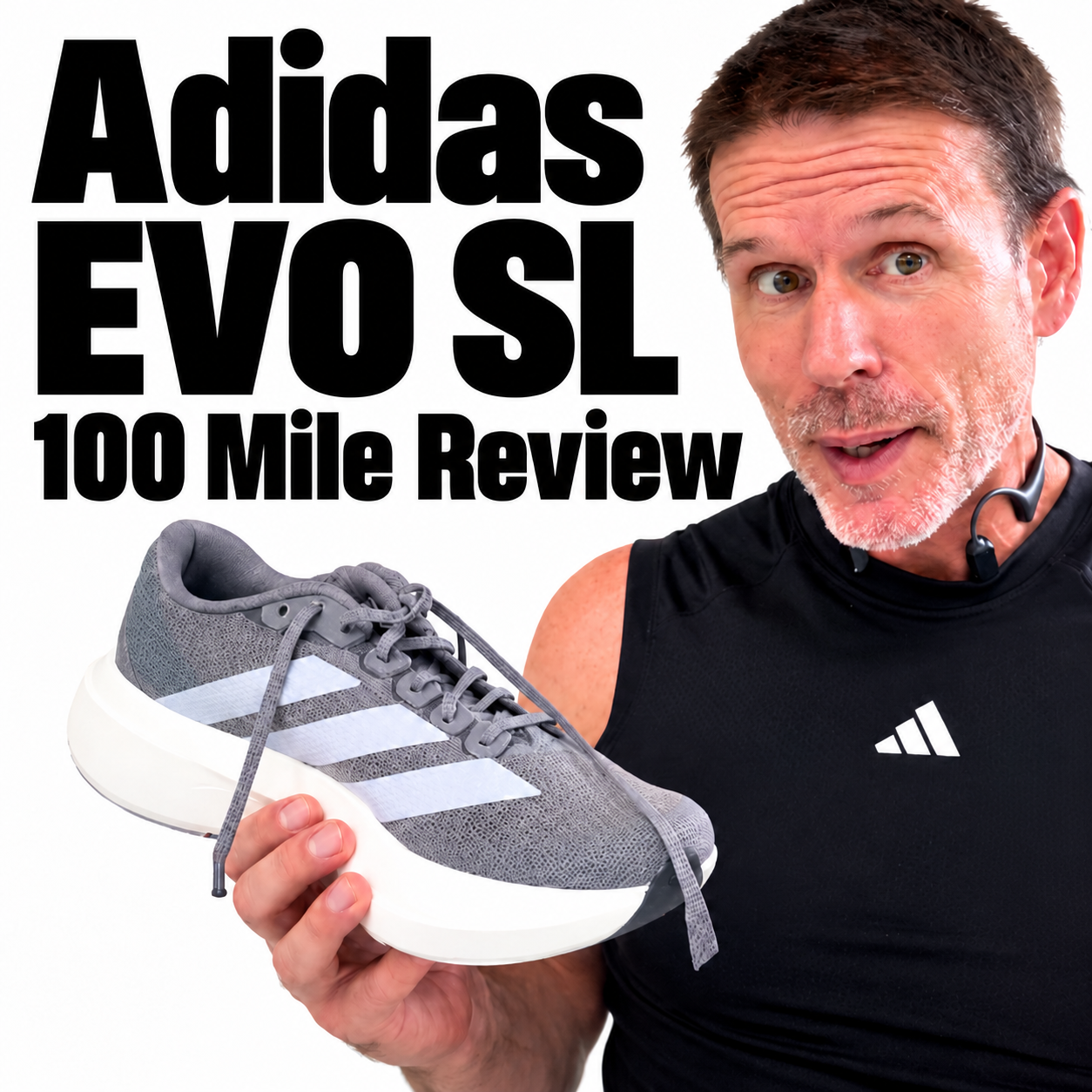
Adidas Adizero Evo
SL 100-Mile Review: Is It the Best Daily Trainer?
The Adidas Adizero Evo SL has now passed 100 miles of testing, and at this point I can say it with some confidence: this is one of the best daily running shoes I’ve ever used.
In fact, it might be my favourite.
When I first bought the Evo SL, I wasn’t completely sure I needed it. I already had the Mizuno Neo Zen, which I really liked, and the Evo SL appeared to occupy a similar position in my rotation.
That changed very quickly.
The Evo SL has become one of the first shoes I reach for when I want something comfortable, lightweight and responsive that makes running feel a little easier. I’ve used it for slow runs, longer efforts of more than 20km, faster sessions and everything in between.
And after more than 100 miles, it still feels excellent.
Adidas Evo SL Key Specs
In my UK size 9, my pair weighs 236g.
The shoe has approximately:
38mm heel stack
32mm forefoot stack
6mm drop
Lightstrike Pro midsole foam
A small midfoot shank for additional stability
No full-length carbon plate
That weight is particularly impressive for a daily trainer with this amount of cushioning.
The Evo SL uses the firmer Lightstrike Pro compound that Adidas used in shoes such as the Adios Pro 3 rather than the softer formulation found in the newer Adios Pro 4.
That is important because this older Lightstrike Pro has already demonstrated that it can be extremely durable.
After 100 miles, I'm seeing exactly that.
How I've Tested the Adidas Evo SL
I've now run more than 100 miles in the Evo SL across a wide range of sessions.
That has included:
Easy runs
Faster running
Long runs of more than 20km
General daily training
Pre-marathon training sessions
I first ran in the shoe in Berlin and continued using it throughout my London Marathon training.
What surprised me most is just how quickly the Evo SL became one of the shoes I automatically reached for.
There are plenty of running shoes I enjoy testing.
There are far fewer that I genuinely want to put on when I'm not reviewing anything and simply want to enjoy my run.
The Evo SL falls firmly into the second category.
The Midsole Is Where the Evo SL Comes Alive
The real magic of the Evo SL is its Lightstrike Pro midsole.
If you've run in the Adidas Adios Pro 3, you'll recognise some of the feeling here.
The foam is relatively firm and dense compared with some of today's softer superfoams, but it has a really satisfying responsiveness to it. Rather than sinking deeply into the shoe, I feel like I'm getting something back from the ground.
It also appears to get better with use.
Lightstrike Pro can take a little time to break in, and after more than 100 miles the foam feels every bit as good as it did when new — possibly better.
There is no sense so far that the midsole has gone flat or lost its responsiveness.
For a shoe intended to absorb a large amount of daily mileage, that's an excellent sign.
The Geometry Works Brilliantly for Forefoot Strikers
The foam is only part of the story.
What really separates the Evo SL from many other daily trainers for me is its geometry.
I'm predominantly a forefoot striker, and when I land around the front of the shoe I immediately engage with the curvature of the rocker.
That gently tips me forward into the next stride.
It isn't an aggressive sensation like you sometimes get from a full carbon-plated racing shoe. Instead, there is just enough forward momentum to keep the stride flowing naturally.
That's exactly what I want.
I generally don't enjoy shoes that feel very flat underneath the forefoot. I like a shoe that gives me some sensation of rolling forward through the stride, and the Evo SL does that exceptionally well.
There is potentially a slight trade-off in stability because of that geometry, and runners who prefer a very flat or planted platform may feel differently about it.
For my running style, however, the geometry is one of the shoe's biggest strengths.
The Evo SL Is Incredibly Versatile
Versatility might be the Evo SL's greatest achievement.
I've run slowly in it.
I've taken it beyond 20km.
I've pushed the pace.
And I genuinely think I could race in it.
There aren't many running shoes that can cover that entire range successfully.
Most daily trainers are excellent within a relatively narrow window. They might be very comfortable for easy running but feel cumbersome at speed, or they might be lively at faster paces while feeling awkward when you slow down.
The Evo SL manages to work across both ends of the spectrum.
That's what makes it such an easy shoe to recommend.
If I were travelling and could only take one pair of running shoes, this would be very high on the list.
Could You Race in the Adidas Evo SL?
Absolutely.
At some point I want to race a 5K or parkrun properly in the Evo SL and see just how close it can get to my carbon-plated racing shoes.
I suspect the gap might be smaller than some people expect.
The Evo SL doesn't have the full carbon plate of a dedicated supershoe, but it is light enough, responsive enough and aggressive enough geometrically that racing in it wouldn't feel like a compromise for many runners.
For runners who don't want to buy a separate carbon racing shoe, that makes the Evo SL particularly interesting.
You could realistically use it for daily training, faster sessions and occasional races.
Few shoes offer that amount of flexibility.
Adidas Evo SL Upper and Fit
The upper has performed extremely well over the first 100 miles.
There is plenty of volume around the forefoot, which works particularly well for my wider feet and larger toes.
I haven't experienced any major discomfort, and the shoe remains comfortable over longer distances.
The heel also works well.
There is useful padding around the heel collar, a semi-rigid heel counter and a secure overall lockdown.
After more than 100 miles, the upper has remained intact.
I've seen reports of the Adidas stripes or other elements separating on some pairs, but I haven't experienced that with mine.
My pair is slightly dirty, as you'd expect, but structurally there are no issues.
The Laces Are the Weak Point
There aren't many things I dislike about the Evo SL, but the laces are one of them.
They're simply not particularly good.
The tongue could also be improved. It can move around slightly, and I think a gusseted tongue would probably improve the overall fit.
Neither issue is serious enough to damage my opinion of the shoe.
Once I've achieved a good lockdown, everything works.
But considering how well Adidas has executed the rest of the shoe, the laces stand out as an obvious area for improvement.
Adidas Evo SL Durability After 100 Miles
Durability has been excellent.
There is visible scuffing on the outsole and some cosmetic wear, which is completely normal after this amount of running.
However, the important rubber areas remain intact.
The Lightstrike Pro foam also feels essentially unchanged.
There is some expected creasing around the midsole, but I haven't noticed any meaningful deterioration in performance.
The upper is holding together well too.
That's encouraging because Adidas could easily have sacrificed durability while trying to keep the Evo SL lightweight and relatively affordable.
It hasn't.
Based on the first 100 miles, this feels like a shoe that should comfortably absorb plenty more training.
Evo SL vs ASICS Novablast 5
The Novablast 5 was one of my favourite daily trainers, but for me the Evo SL takes the concept to another level.
The biggest difference is the geometry.
The Novablast is comfortable and enjoyable, but it doesn't give me the same sensation of being guided forward through my stride.
I also prefer the Evo SL's Lightstrike Pro foam.
It feels:
Firmer
More responsive
More energetic
Better suited to faster running
The Novablast remains an excellent daily trainer, particularly for runners who prefer a softer experience.
But if I had to choose between them, I'd take the Evo SL.
Evo SL vs Hoka Mach X2
The Hoka Mach X2 is another shoe capable of handling both daily mileage and faster running.
It arguably has a little more pop than the Evo SL, but I think the Adidas is the more versatile option overall.
The Evo SL is also lighter on foot and was around £30 cheaper based on the prices when I tested them.
I've also found the Evo SL upper more accommodating, while some runners have experienced issues around the heel of the Mach X2.
If outright speed were the only consideration, the Mach X2 remains interesting.
As an all-round running shoe, I'd choose the Evo SL.
Evo SL vs ASICS Superblast
The Superblast is another shoe people often mention when discussing highly versatile daily trainers.
For me, though, the Evo SL has a major advantage.
I would happily race in it.
I don't personally get that same racing sensation from the Superblast.
The Evo SL feels lighter, more aggressive and better suited to changing pace.
The Superblast has plenty of strengths, particularly for long-distance training, but the Evo SL covers a wider range of running for me.
Is the Adidas Evo SL Comfortable?
Very.
What's particularly impressive is that the Evo SL manages to be comfortable without relying on an excessively soft midsole.
The cushioning protects the legs well, but there is still enough firmness and responsiveness to make the shoe feel fast.
That balance is difficult to achieve.
It's one of the reasons I continue reaching for the Evo SL when I want a shoe that feels good without being overly aggressive.
Is the Adidas Evo SL Good for Long Runs?
Yes.
I've taken the Evo SL beyond 20km without any issues, and I would happily continue using it for longer training runs.
The combination of cushioning, low weight and efficient geometry works particularly well when the distance starts increasing.
Unlike some heavier daily trainers, it doesn't begin feeling cumbersome later in the run.
Is the Adidas Evo SL Good for Faster Running?
Definitely.
This is arguably where it separates itself from more traditional daily trainers.
The Lightstrike Pro foam responds well when you increase the pace, while the rocker geometry helps move you quickly through the stride.
I wouldn't hesitate to use it for tempo running, faster steady sessions or shorter intervals.
Is the Adidas Evo SL Worth the Money?
At around £130 when I bought and tested it, the Evo SL represented outstanding value.
It's still not a cheap running shoe in absolute terms, but compared with many modern premium trainers and super trainers, the pricing is extremely competitive.
More importantly, you're potentially replacing several different types of shoe with one model.
You can:
Run easy
Run long
Run fast
Train daily
Potentially race
When one shoe can genuinely cover that much of your running, the value proposition becomes very strong.
Who Should Buy the Adidas Evo SL?
The Evo SL should work particularly well for runners looking for a lightweight and responsive daily trainer that doesn't restrict them to one particular pace.
I'd especially recommend it to runners who:
Want one shoe for several different types of training
Enjoy firmer, responsive foams
Like a noticeable rocker sensation
Want a lightweight daily trainer
Occasionally want to race in their training shoes
Enjoyed the Lightstrike Pro feeling in the Adios Pro 3
Want something faster than a traditional daily trainer
Forefoot and midfoot runners may particularly appreciate the geometry.
Who Might Not Like It?
The Evo SL won't necessarily suit everyone.
You might prefer something else if:
You want an extremely soft midsole
You need a highly stable platform
You dislike curved or rockered geometry
You prefer a traditional, flatter daily trainer
You need substantial guidance or support
The laces are also disappointing, although that's a relatively minor complaint.
Adidas Evo SL 100-Mile Verdict
After more than 100 miles, my opinion of the Adidas Evo SL has only improved.
The midsole remains responsive.
The outsole is holding up.
The upper remains intact.
And most importantly, I still actively want to run in it.
That's probably the biggest compliment I can give any running shoe.
I test a lot of shoes, so there is always something else sitting around waiting to be worn. Despite that, the Evo SL has accumulated 100 miles surprisingly quickly because I continue choosing it.
It's light, responsive, comfortable and unusually versatile.
I can run slowly in it.
I can run long in it.
I can increase the pace.
And I could genuinely race in it.
At the time of testing, there simply wasn't another daily trainer around the same £130 price point that I felt could match that complete package.
The Adidas Evo SL is currently my daily trainer of the year and one of my favourite daily running shoes I've ever tested.
Pros
Extremely lightweight for a daily trainer
Excellent Lightstrike Pro midsole
Responsive without feeling overly aggressive
Superb rocker geometry
Works at slow and fast paces
Capable of handling longer runs
Light enough to race in
Comfortable forefoot fit
Excellent durability after 100+ miles
Strong value at around £130
Great-looking shoe
Cons
Poor laces
Tongue could be better secured
Rockered geometry may not suit everyone
Not the most inherently stable daily trainer
Final Score
9.5/10
The Adidas Evo SL combines much of what makes Adidas' high-end racing shoes exciting with the practicality and durability needed from a daily trainer.
More than 100 miles later, it remains the shoe I reach for when I want my daily run to feel that little bit better.
And I suspect this pair has plenty of miles left in it.
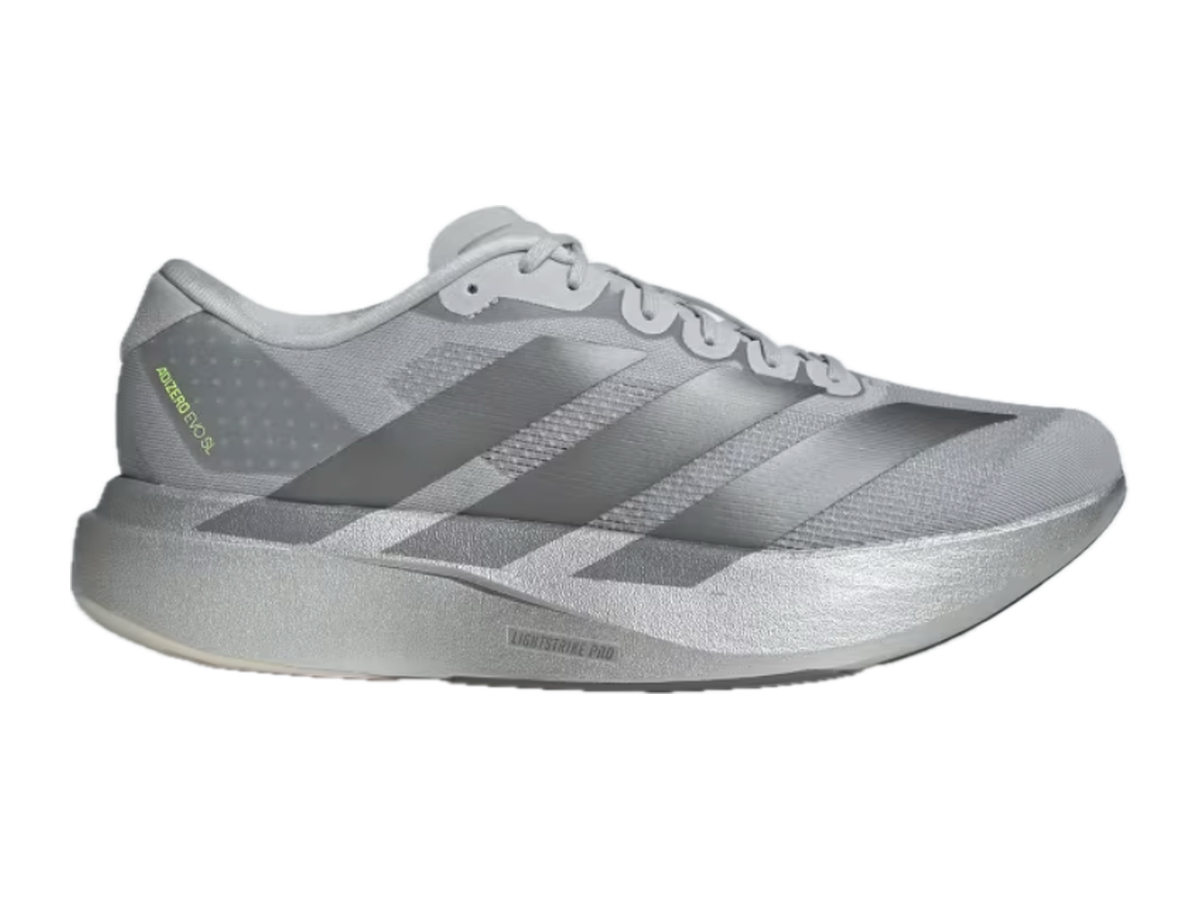
“The Adidas Evo SL combines much of what makes Adidas' high-end racing shoes exciting with the practicality and durability needed from a daily trainer.
More than 100 miles later, it remains the shoe I reach for when I want my daily run to feel that little bit better.And I suspect this pair has plenty of miles left in it”
”
Want to Know More?
If you're interested in finding out more about this shoe - Please fill in the following form.